Missed Leaks vs. False Alarms: The Real Cost of Poor Leak Detection in Liquid-Cooled Data Centers

A leak detection system can fail in two ways: it can miss a real leak, or it can cry wolf. Both failures are expensive, and both are becoming more consequential as liquid cooling spreads through AI infrastructure. That is not because liquid cooling is inherently less reliable than air cooling. Well-designed loops run for years without incident. What changes is the geometry of the problem. A liquid-cooled rack multiplies the number of mechanical interfaces (quick disconnects, manifold connections, cold-plate fittings, hose terminations), and moves them right next to the servers, or inside the rack itself. The question is no longer whether a loop can leak, but how fast and how precisely the operations team finds out that it has. That answer is set by the detection layer, and it is the one variable an operator can specify in advance.
The Cost of a Missed Leak
A missed leak is easy to picture. Coolant reaches live IT equipment, servers go down, and the team has to locate the source, clean the area and repair the damage. In a liquid-cooled rack, even a small leak can spread fast and affect several servers before anyone notices. By the time it becomes visible, the cost is already higher than it needed to be.
The damage is not always confined to the room where the leak starts. In 2023, water intrusion at a large European colocation facility reached battery equipment and started a fire. One major cloud provider lost an entire region for more than 24 hours, and its worst-hit zone stayed degraded for weeks. That was a conventionally cooled facility, with the water in the plant rather than in the rack. Liquid cooling closes that distance.

The Cost of a False Alarm
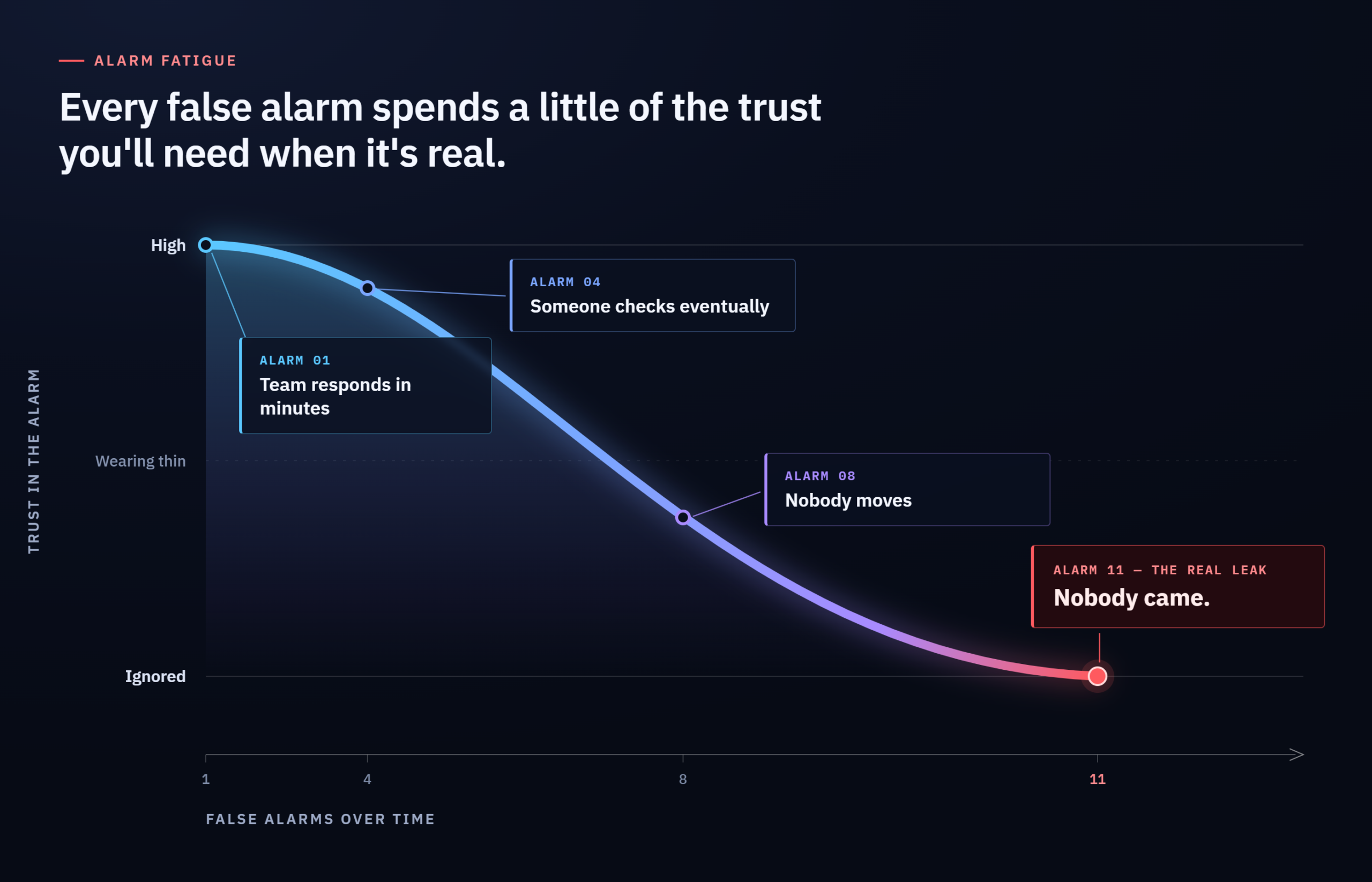
A false alarm is less obvious, but just as costly. When alerts turn out to be false often enough, teams stop trusting them, and a real leak goes unnoticed simply because the last ten alarms were nothing. In practice, few operators let a single alarm stop a CDU or close a valve, and that caution is justified: cutting cooling to high-density racks can do more damage than the leak itself. But caution has a price. If the alarm only reports that something on a circuit is wet, or points to the wrong location in an adjacent zone, someone has to walk the floor and verify before anything else can happen, and the clock keeps running. Every nuisance alarm eats that time and makes the next one easier to dismiss. The real cost of a false alarm is not an unnecessary shutdown. It is losing the confidence to act on an alarm immediately.
Two Failures, One Root Cause
It is tempting to treat these as opposite problems and trade one off against the other: turn the sensitivity up and live with the nuisance alarms, or turn it down and accept the risk. They are not opposites. Both come from the same deficiency: a detection layer that cannot say precisely where the fluid is, how much of it there is, and whether there is more than one leak on the same circuit. Fix that, and neither failure mode has anywhere to live.
Start With the Specification
Avoiding both failure modes starts long before installation, at the specification stage. Three questions do most of the work.
- Where would the fluid go first? Map the failure points across the whole loop: quick disconnects, manifolds, cold-plate connections, valves, pump seals, CDU service joints. The path the fluid takes defines where sense cable has to run.
- What liquid is being monitored? Conductive (water, glycol-water) or non-conductive (dielectric fluid, oil)? More than one fluid on site? That determines the technology.
- How precise must the answer be? Located to the meter along the cable, or just the zone? And at what sensitivity: a few drops, or only a significant flow?
For a fuller list of the questions a liquid-cooled data center manager should be asking, read this article "Choosing a Leak Detection System for a Liquid-Cooled Data Center: The Questions to Ask First".
Then Choose Digital, Not Analog
Once the specification is clear, the technology choice follows from it. A detection system for a liquid-cooled data center should be digital rather than analog, because a digital architecture is what removes both failure modes at once. A digital sense cable pinpoints a leak to the exact spot rather than reporting that something on the circuit is wet. And because every cable segment reports on its own through a built-in microcontroller, a second leak is still detected even when it occurs on the same circuit as the first, which is exactly the case an analog loop is structurally unable to see.
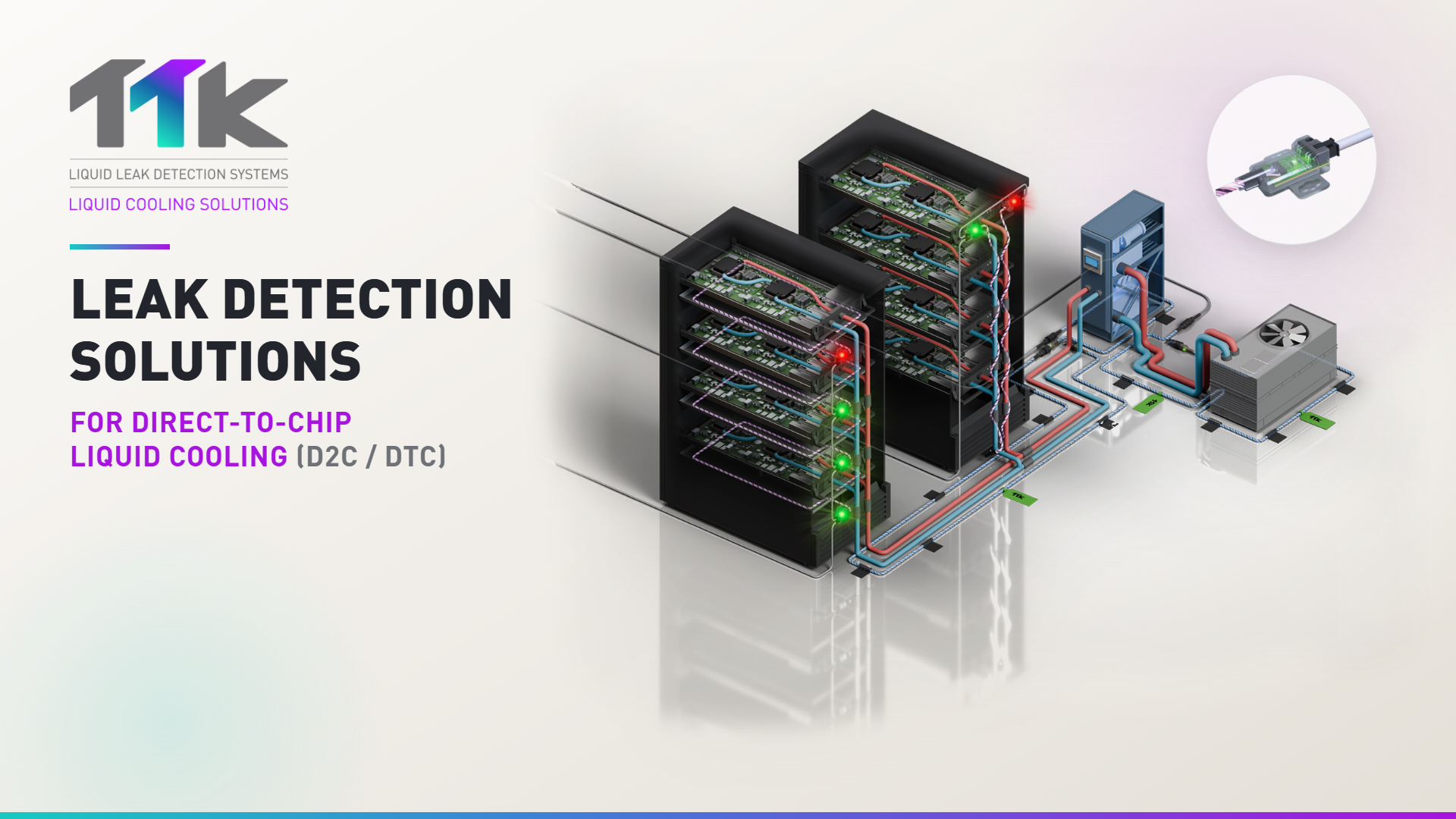
All cables connect back to a digital monitoring panel that handles several kilometers of cable across multiple zones at once and answers the only two questions that matter during an incident: where the leak is, and whether there is more than one. Integrated with the BMS, it can also trigger an automatic response (closing a valve, stopping a pump, powering down a zone) and notify the right people directly. TTK's FG-NET is built for exactly this role.
A good detection system turns an unknown condition into a located, verified fact early enough for the team to act. It is the first step in keeping coolant where it belongs, followed by containment and isolation, a written response procedure, a commissioning test that proves an alarm actually reaches the right people, and re-verification whenever racks and manifolds move.
TTK already protects leading liquid-cooled data centers across the globe, and works with operators, consultants and integrators on exactly that first step, from detection layout through commissioning. We are glad to review a design with you before anything is installed.